Paper vs. Pixels: A Strategic UX Research Study on Unifying the Fragmented Reading Ecosystem
Amazon Kindle
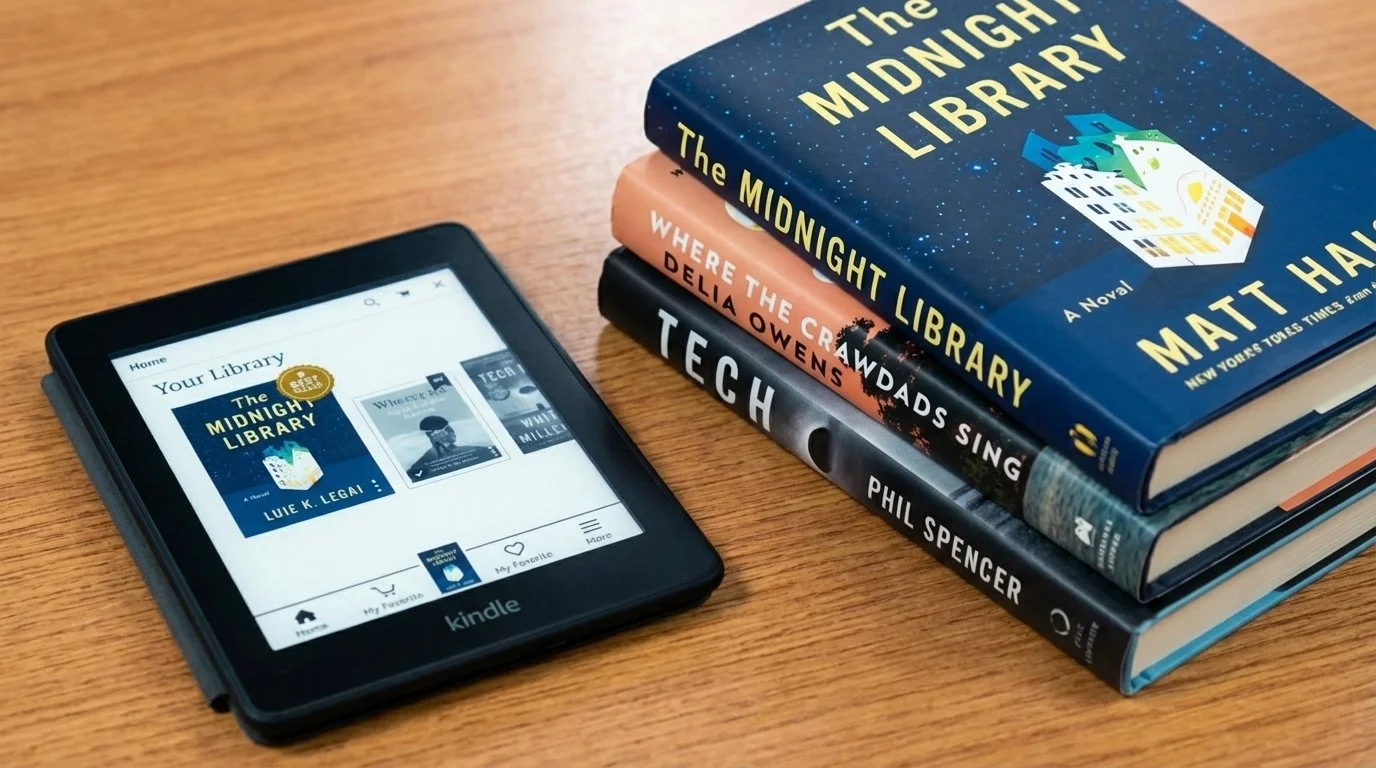
A massive segment of readers are "hybrid" — consuming both print and digital formats. However, the Kindle ecosystem treats these formats as mutually exclusive, forcing users to manually fragment their reading identities, collections, and progress tracking.
Through rigorous mixed-methods research grounded in academic behavioural analysis, I discovered that readers use physical books as tangible "trophies" of their identity — a feeling of true ownership digital files fail to provide.
Hybrid readers experience a fragmented and frustrating user journey.
Because the Kindle ecosystem is entirely blind to a user's physical book consumption, this "data deficit" breaks the digital experience in three key ways:
- Disjointed Reading Identity: Physical books cannot sync with digital trackers, denying users a unified "shelf."
- Accidental Duplication: Without a centralised inventory, users frequently accidentally purchase digital copies of books they already own in print.
- Broken Recommendation Engine: Kindle's algorithm only sees digital purchases, frequently recommending books the user has already read in print.
Hybrid readers view physical and digital formats as interchangeable commodities driven purely by price or convenience.
Users stop using the app while reading print because the app lacks a mechanism to log physical progress.
Irrelevant recommendations — suggesting a book the user already owns in print — degrade trust in the platform.
A cascading, multi-method research funnel to bypass self-reported bias.
- Phase 1 — Academic & Market Research: Literature review establishing the "hybrid reader" as a massive market segment.
- Phase 2 — Competitive Analysis: Analysed how other media giants (Spotify, Steam) solved the physical-to-digital divide.
- Phase 3 — Exploratory Interviews (N=15): 45-minute remote sessions exploring the full book lifecycle — how users select, buy, read, and track physical vs digital books.
- Phase 4 — 14-Day Diary Study (N=10): Participants logged every reading session, format switch, and friction point in real time — eliminating recall bias.
- Phase 5 — Contextual Inquiry (N=5): 60-minute in-home sessions observing actual physical artefacts — bookshelves, habit trackers, and manual workarounds.
"The best research you can do is talk to people."
— Sir Terry PratchettThree macro-themes emerged from 300+ individual data points.
❌ Hypothesis 1 REFUTED — The "Trophy Shelf" vs. Consumption
Users treat e-books as utility and physical books as identity "trophies." By only tracking digital purchases, Kindle fails to capture a reader's true identity. Users don't choose format based on price — physical books serve a deep psychological need.
→ Recommendation: "Scan to Digital Shelf" — an in-app ISBN scanner so users can log physical books with an "Owned in Print" badge, creating a unified library.
✅ Hypothesis 2 CONFIRMED — The Tracking Deficit
Kindle engagement drops to zero when users read print. Because offline reading breaks "Days Read" streaks, users are forced to abandon the app for third-party habit trackers like Goodreads and StoryGraph.
→ Recommendation: Allow users to manually log reading sessions for "Owned in Print" books.
✅ Hypothesis 3 CONFIRMED — Algorithmic Blindness
Recommending books users already own in print shatters algorithmic trust and drives users to third-party apps for discovery.
→ Recommendation: Sync physical library data with the store algorithm to avoid redundant recommendations.
Shifting Kindle from a closed e-reader to an inclusive "Unified Reading Hub."
Designing for the Ecosystem: By observing users' physical spaces, I learned that the Kindle experience doesn't end when the app closes. True product strategy means designing for the user's entire ecosystem — bridging digital tools and physical bookshelves.
Unresolved Edge Cases: The next research phase must address the Library Dilemma (how to differentiate owned vs. borrowed books) and Household Sharing (multiple users scanning the same physical copy).